

Overview
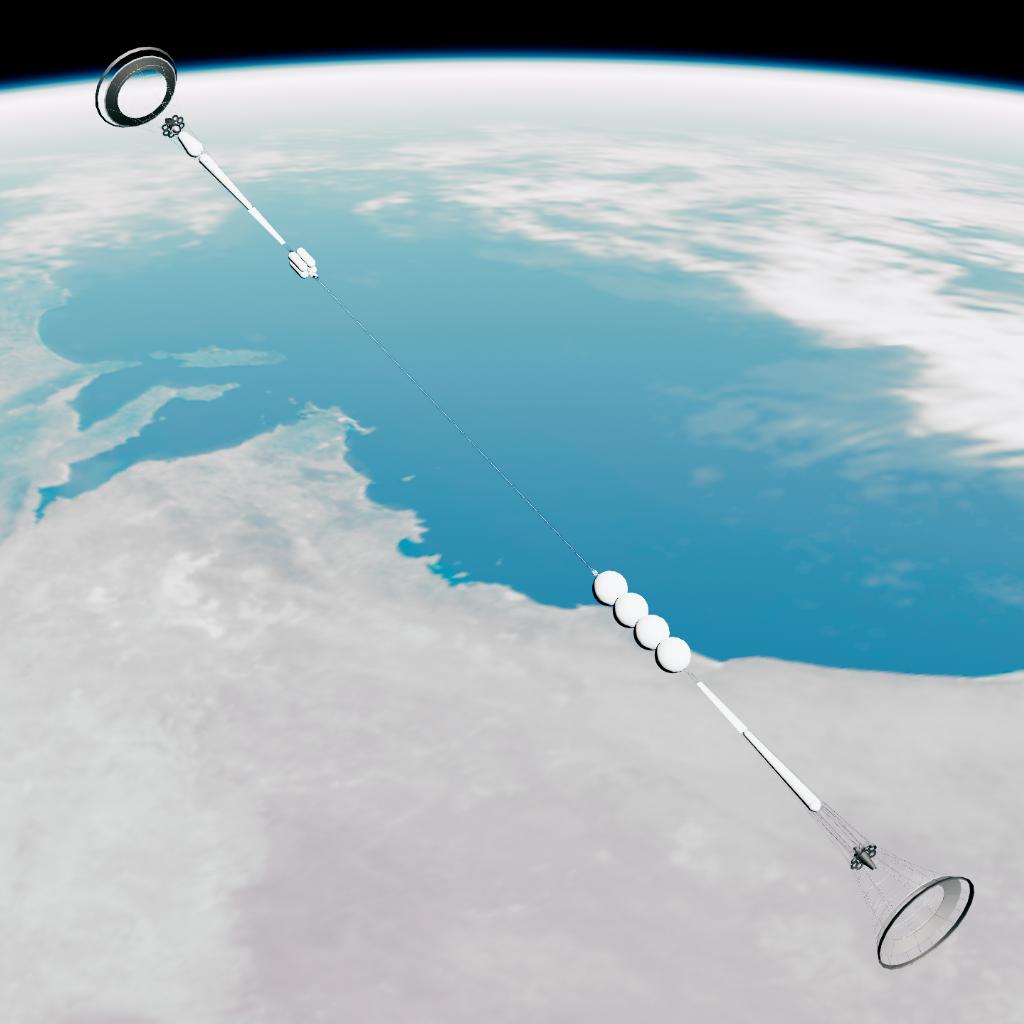
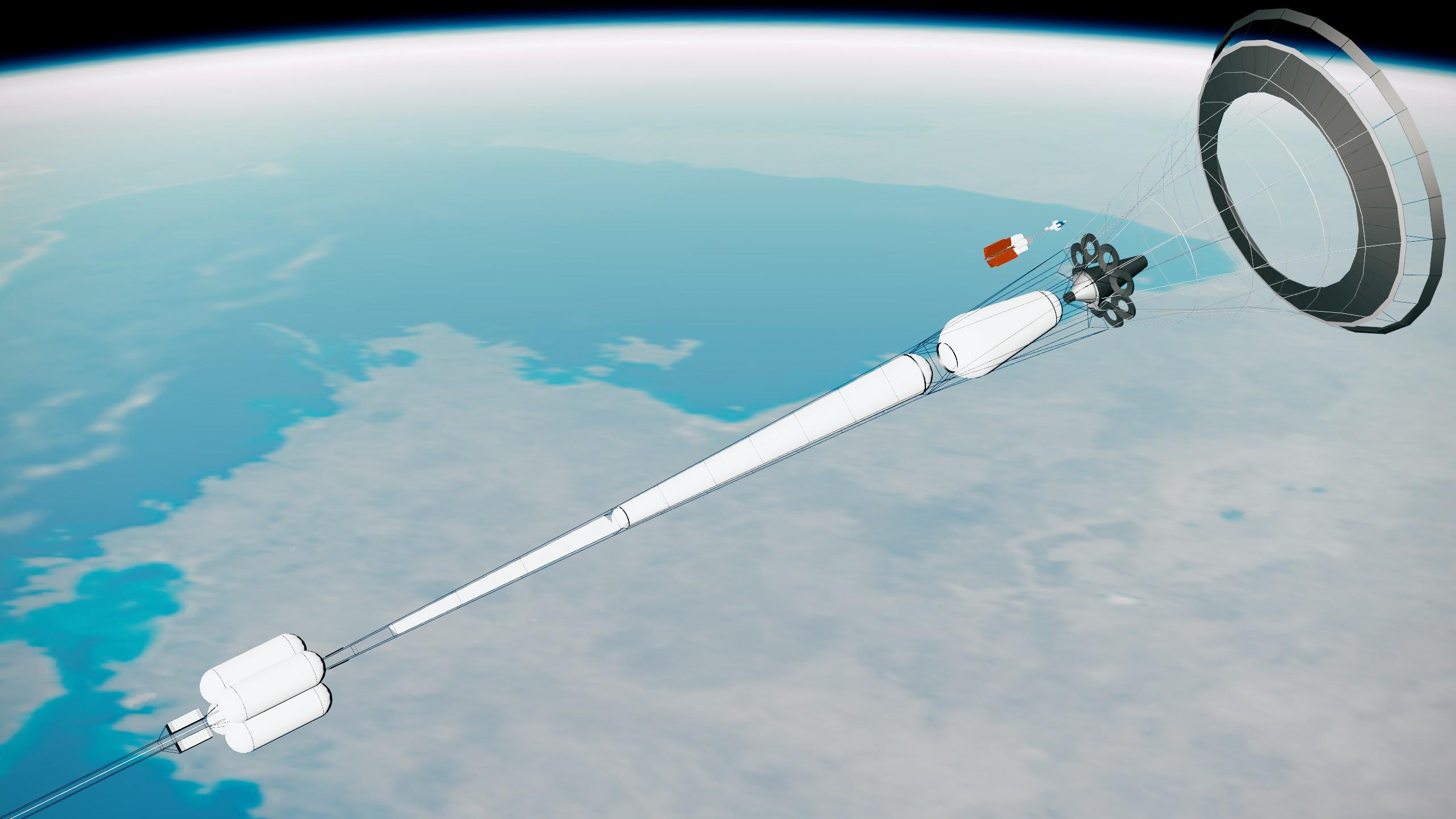
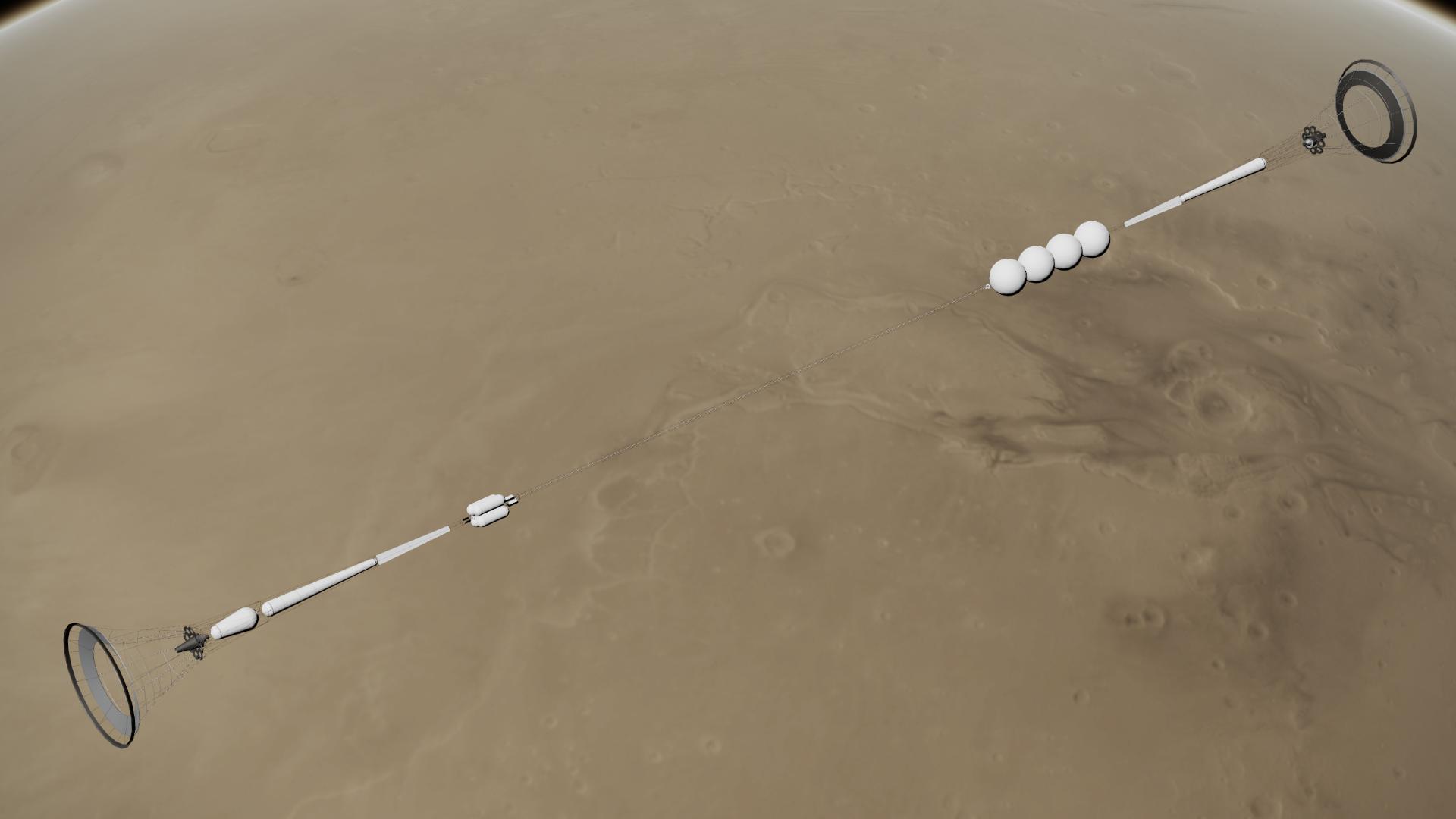
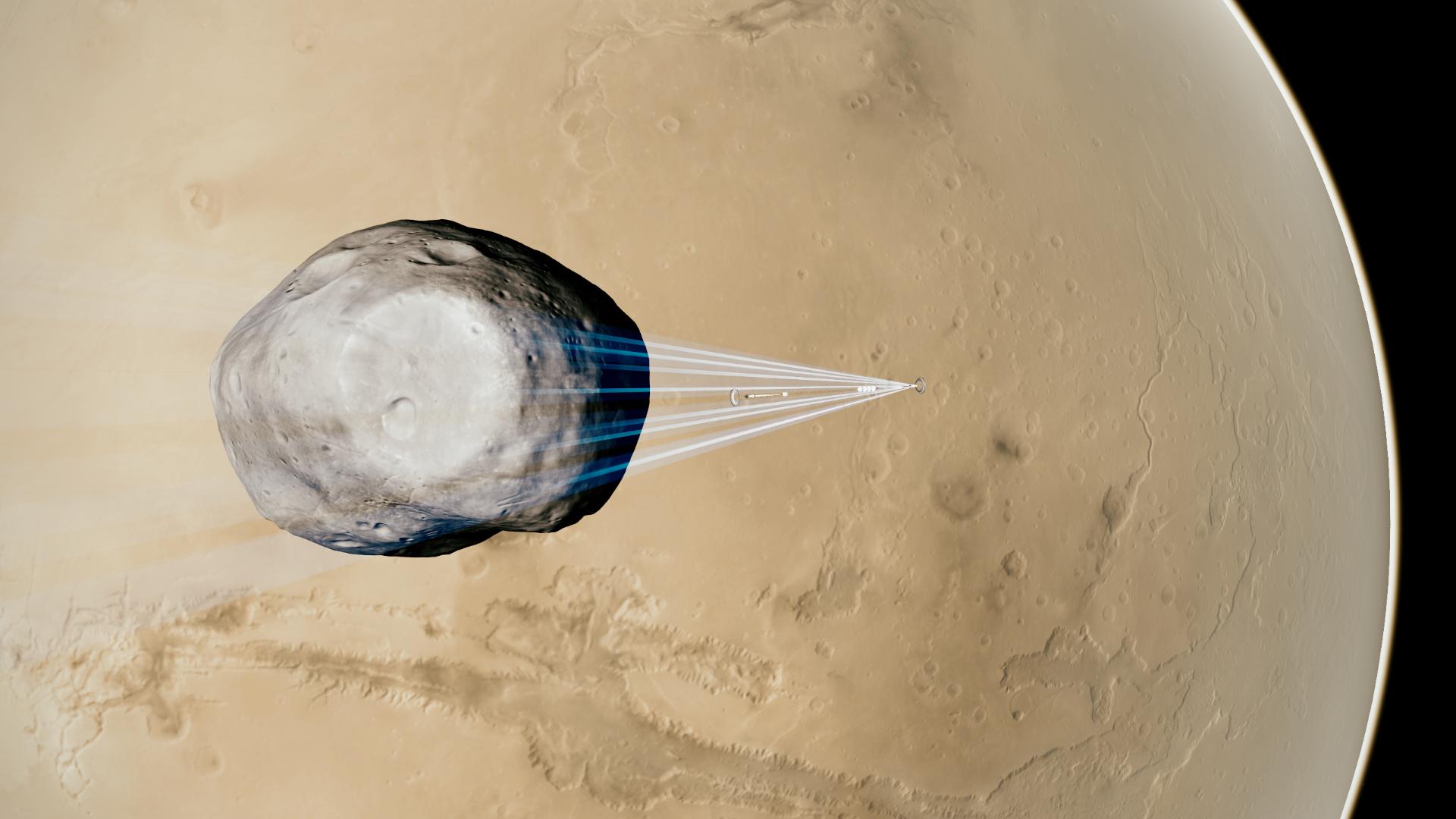
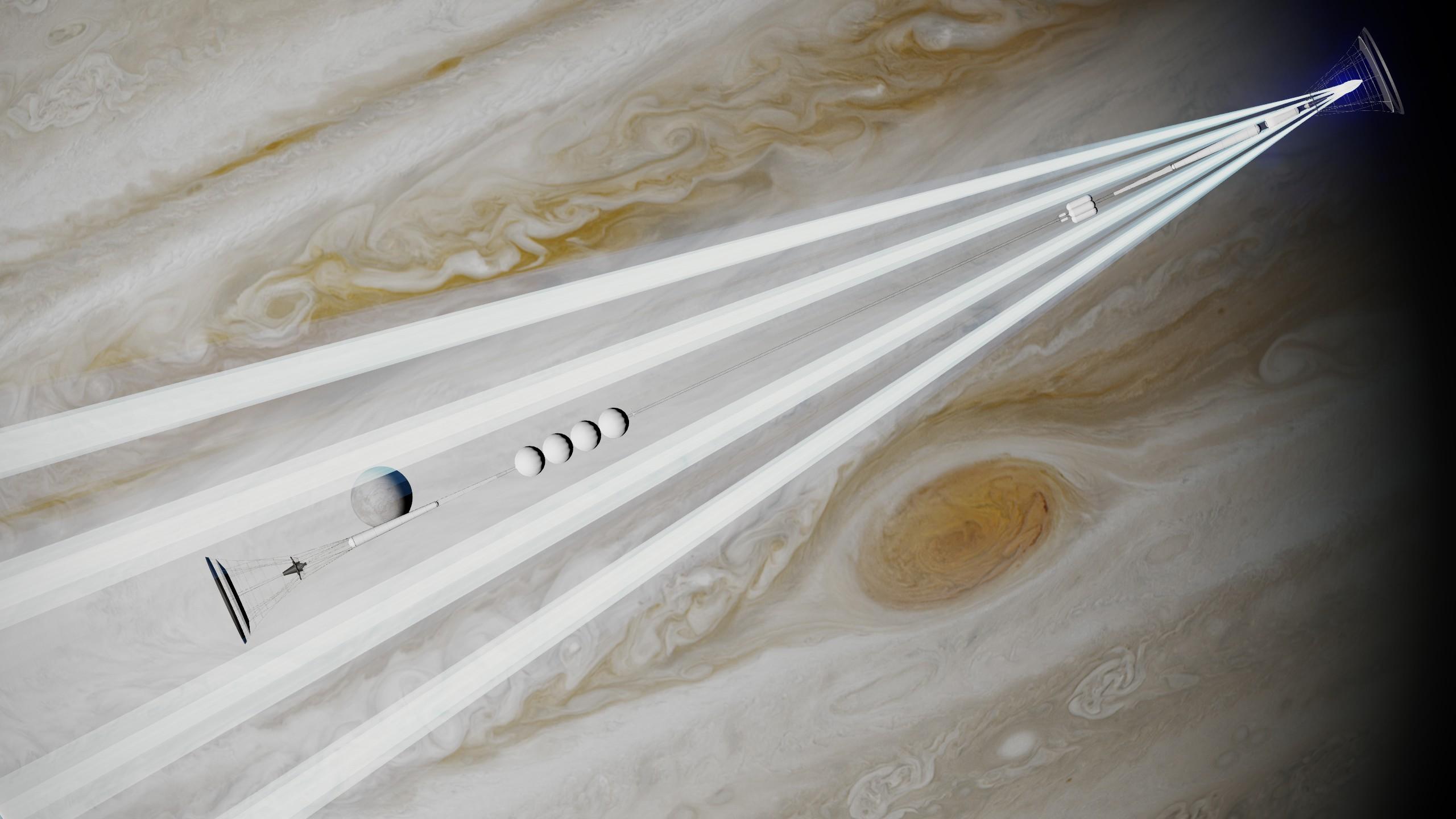
This is a recreation of Jim Powell's and Charles Pellegrino's Valkyrie spacecraft concept, a giant interstellar vehicle made from two engine sections held together under tension by a cable. If you want to know more, the Atomic Rockets website has this entry on the Valkyrie spacecraft with lots of details and information, I would recommend reading through it. The look & proportions of this build were inspired by Retro Visor's " 'The Chandelier' - Project Valkyrie " post, since I liked the design there. I tried to make this recreation look similar to it and still have it make sense with real design principles and physics in mind.
You may have noticed the suspiciously long Design Details section in the description; I pretty much did a full study of the physics for this craft, and because of this I also altered some aspects to be different from how they're described in the original concept. The reasons for the changes are laid out in full painful detail in that section.
Craft Characteristics
Physical Characteristics
ΔV : [ 541,941,303m/s (1.80c) ]
Mass : [ 8,935kt | fuel mass: 7,919kt ]
Mass ratio : [ 8.79 ]
Acceleration : [ ~1.5g ]
Engine Performance
Engine Fuel : [ 75% hydrogen & 25% anti-hydrogen, uranium dust ]
Engine Exhaust : [ relativistic protons (83.1% c) ]
Specific Impulse : [ 25,418,594s ]
Activation Groups
[AG1] : "▲Front Engine"
[AG2} : "▼Aft Engine"
[AG3] : "Fuel Cell"
/[ ]
[AG7} : "Vizzy Input Console"
/[ ]
The Vizzy Input Console is designed to allow interaction with running programs mid flight; pressing AG7 will bring up a window for a typed command input which the console will execute. The console puts certain info, like command errors, into the flight log. What commands can be typed is explained in text comments next to the console program. This console was made mostly as a concept demonstrator, and doesnt have everything fully integrated; I hope to develop it more in future craft.
This craft has one program integrated into the console; The "FlightProgram". The flight program is used to execute burns resulting in a brachistochrone trajectory from one planet to another. The program has limited accuracy though; the result of non exact math and vizzy jank. Manual input can be given through the 1 & 2 sliders to allow for greater accuracy.
Design Details
Features
Unlike the original concept which has a 50% matter & 50% antimatter mixture, This recreation has a 25%-75% antimatter-matter ratio (the next propulsion concept paragraphs explain why). Super-cooled LH2 is stored in a centralized tankage system feeding both engines made of 4 spherical 342 meter diameter tanks. Anti-hydrogen is stored in engine dedicated tanks which levitate antimatter using axial magnetic fields and charged tank walls similarly to Penning traps. The anti-hydrogen is stored as solid snowflakes, cooled down to <1 kelvin to reduce the sublimation rate; this is colder than the ~2.7 kelvin CMB of empty space, requiring radiators hooked up to a refrigeration cycle operating at something like ~10-20 kelvin to stop the antimatter from heating up over time. The uranium dust the engine needs is stored in conical tanks with walls and internal features made from a neutron absorbing material to minimize the reactivity of the mass of uranium. The uranium mass inside the tanks also acts as a gamma ray shield for the antimatter and other ship components further down.
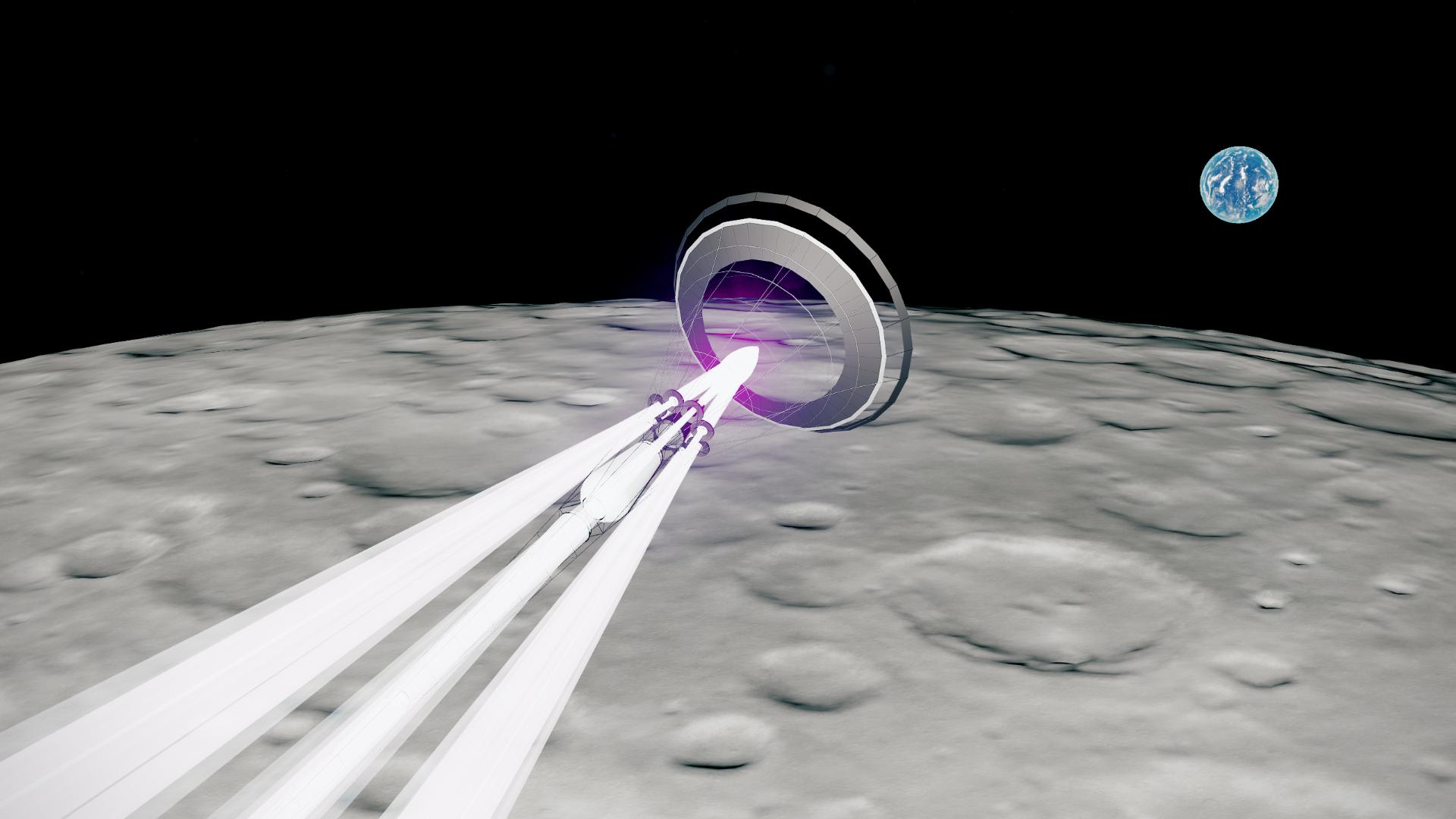
The engines themselves are made from 3 ultra-high temperature superconducting magnetic sections; a top dish generating a downward concentrating magnetic field which confines plasma particles horizontally, 8 redirecting magnets which redirect exhaust particles downward off their helical paths in the confinement field as they're ejected, and a central magnetic cone which helps better shape the magnetic fields; The magnetic cone section also helps generate the axial magnetic field used to confine and levitate the antimatter in its tanks. The top dish also supports a liquid droplet radiator present in the base Valkyrie design, which dumps heat absorbed by gamma ray shielding on the engine section its attached too.
Anti-hydrogen flakes get levitated and launched directly into the middle of the engine confinement region; regular hydrogen gets ionized and launched through neutral beam injectors into the outer area of the plasma and spirals inwards over time. When a proton gets fully heated to 750 meV of kinetic energy, or 8,710,555,541,700 kelvin (8.71 trillion kelvin), the magnetic field isn't able to contain it and it rapidly escapes out the bottom of the plasma towards the redirecting magnets.
The structure of the spacecraft would be mostly made from high tensile strength carbon nanotubes or diamond nanothreads, with some compressive carbon fiber composite scaffolding at certain points; however near the engine tops where gamma radiation flux is most intense, these structural materials would be switched out for compressive boron-doped tungsten fiber scaffolding, due to it serving a double role as both a strong structural element and gamma radiation shield due to the tungsten, and tensile boron nitride nanotubes, due to them being able to withstand a higher temperature before decomposing. The heat absorbed by gamma ray shielding will be more than enough to power the spacecraft; when engines aren't on the decay heat of the uranium dust can be used to power the spacecraft. The spacecraft contains thin sheets of Kevlar, or another type of strong fiber, folded up ready to be deployed before deceleration starts to clear any large debris In front of the ship.
Pellegrino sometimes lists Valkyrie designs into versions labeled as marks. I suppose this Valkyrie ISV can be thought of as a mark-III design; Mark-Is would be smaller, scaled down tensile spacecraft for constant thrust 1g flight across the Solar System, powered by antimatter catalyzed hydrogen fusion; mark-IIs would be the first interstellar rated vehicles; mark-IIIs such as this spacecraft would introduce a heavy metal dust component to the plasma to bring efficiency up; mark-IVs could have denser propellants like liquid helium or even lithium dust dedicated for annihilation with anti-hydrogen, along with regular hydrogen dedicated only to act as an exhaust, allowing for a more compact design with shrunken fuel tank sections, possibly at the cost of some efficiency. Perhaps in the future I'll make a real-physics based Mark-I design to complement this one.
Original Propulsion Concept
The original design proposes annihilating a 50% hydrogen & 50% anti-hydrogen mix, this would create an exhaust of pure pions. As far as I know the assumed Specific Impulse value for the engine isn't given, but it can be guesstimated from known values. A top speed of 92%c is quoted for a Valkyrie with a fuel-mass ratio of 22 which also ejects its whole front engine section before decelerating to save weight. If with engine jettison this setup results in a mass ratio of 22/0.75 (or simply 29.3), then an exhaust velocity of 94%c (0.94c is often quoted as the velocity of pions resulting from proton-antiproton annihilations) gives results similar to what is stated. A Valkyrie with a mass ratio of 29.3 and an exhaust velocity of 94%c will have a maximum speed of 91.984%c, very close to the 92% value often given. Sadly, there are several reasons which make this 94%c exhaust velocity value very idealized, and not actually achievable in reality.
An average of 5 pions are created in a proton-antiproton annihilation, and on average 2 of these are neutral pions with the other 3 being positively & negatively charged pions. Neutral pions can't be deflected by a magnetic field since they have no charge, and they also pretty much spontaneously decay into gamma rays right after they are created. This means only 3/5 (or 60%) of pions can be used for thrust, crippling the maximum effective exhaust velocity down to 56.4%c.
Charged pions also decay into muons and neutrinos with a half-life of 18.044 nanoseconds. Even at 94%c, pions can only travel about 15 meters before one half-life passes (this is with relativistic effects like time dilation taken into account). Due to this the magnetic nozzle would have to redirect pions downwards unbelievably quickly, since every meter of distance the pions travel before they are redirected results in lost thrust due to pions decaying into chargeless neutrinos. Even if the pions were redirected after only traveling 5 meters from the annihilation point, still about 20.7% would have decayed; If the pions only travel 1 meter before being redirected, about 4.54% would decay. In reality a nozzle which can efficiently redirect pions in such a short amount of time likely isn't feasible. To illustrate the problem, when running, the engines in this recreation have plasma ellipsoids in which the antimatter-matter annihilations take place; this plasma by itself is 115 meters in diameter, and the distance from the center of the plasma to the redirecting magnets is ~460 meters; at that distance a lot of the secondary muons created from pions themselves also decay into electrons and even more useless neutrinos.
Alternative Propulsion
A propulsion method relying on exhaust particles aside from pions is needed. Lower mass particles will create a higher speed exhaust and give greater Specific Impulse; unfortunately, pions are practically the least massive particles available. Protons are the next best choice; they are 6.7 times heavier, but at least they wont decay away. If protons in the exhaust each receive an average of 1 proton rest mass' worth of energy (938.272 meV), then they will be going at 86.6%c, quite a bit better than the 56.4%c maximum exhaust speed of the pion exhaust (in reality transferring energy from antimatter annihilations to protons would create secondary Delta baryons, which would then decay into a cascading mess of different byproducts; Im not sure how to model that so I'll just assume 100% efficient energy transfer to protons). We could keep increasing the amount of energy each proton receives to create a faster exhaust, but there has to be a limit at some point where energy stops being transferred efficiently, I think its fair to place the limit at each proton having 1 proton worth of kinetic energy. Each proton needing a kinetic energy of 1 proton results in a 75% matter & 25% anti-matter mixture; two protons annihilated with the energy transferred to the other two.
There's still the issue of 40% of the energy escaping through gamma rays from neutral pions, but there's a way to actually recapture some of the energy. When a neutral pion decays it releases two 69.78 meV gamma rays. The hydrogen plasma itself is too sparse to attenuate these gamma rays; The plasma would much better capture longer wavelengths like visible light or ultraviolet. In theory we can add heavy metals into the plasma which would more effectively attenuate the gammas and re-radiate the energy back out as longer wavelength light. Simply adding metal gas into the plasma won't work, since the metal plasma would radiate orders of magnitude more energy away through Bremsstrahlung radiation than it gives back through gamma ray attenuation; instead it would be more practical to add solid dust particles of heavy metals and make a dusty plasma. The environment would have to be carefully tuned so the dust particles don't interact with the plasma much and vaporize. How heated the dust particles become can be tuned with their size thanks to the square-cube law; larger dust particles would have more volume to attenuate gammas and comparatively less surface area to radiate away heat, leading to them heating up more. We can scale the dust particles so they radiate light wavelengths which the plasma can effectively absorb.
To calculate how much heavy metal is needed to attenuate an amount of gamma rays requires the metal's Mass attenuation coefficient; conveniently, this place lists the mass attenuation coefficients of elements up to uranium and up to photon energies higher than the 69.78 meV gammas we're dealing with (normally I'd question how the hell they managed to produce and measure such intense gamma rays but Its convenient so I don't care).
The page lists uranium as the element with the highest mass attenuation for 69.78 meV gamma rays, with a coefficient of ~0.08 cm2/g. Gamma rays would be produced at the center of the plasma and travel outwards. I'll assume that only the inner 1/3 of the plasma is at the full 8.71 trillion kelvin temperature, and the outer 1/3 sections left and right of the center are cold enough to allow solid dust particles to exist there; this leaves 38.333... meters of distance over which attenuation can occur. With a coefficient of 0.08 cm2/g, at a density of 5 kg/m3, 38.333 meters of space will attenuate 78.418% of the gamma rays. This means that 5 kg of uranium in every cubic meter of plasma will be enough to recapture more than half the energy back; At uranium's density of 19,050 kg/m3, this means that ~0.0262% of the plasma's volume will be taken up by the dust particles. I don't know how effectively the hydrogen plasma will absorb the re-radiated energy from the dust particles; I'll simply assume that 50% of the total gamma ray energy gets recaptured. We could keep increasing the amount of uranium in the plasma and capture more energy back, but we would be chasing diminishing returns. I also don't know what happens to a uranium atom nucleus when it absorbs a 69.78 meV gamma ray; the worst case scenario would be spontaneous decay through fission or alpha-decay, If that's the case then other heavy metals like tungsten can be used with slightly lower mass attenuation coefficients.
50% of the gamma ray energy getting captured leaves exhaust protons with 750.6 meV of kinetic energy traveling at ~83.15%c, with a Specific Impulse of 25,418,594 seconds. This result assumes an exhaust of protons, however protons under these energetic conditions would vigorously fuse into heavier elements like helium, lowering engine performance due to heavier exhaust; due to this it is assumed that the protons spend only a miniscule amount of time in the fully heated plasma before getting ejected, making fusion reactions negligible due to the very low confinement time.
GENERAL INFO
- Created On: Windows
- Game Version: 1.3.205.0
- Price: $42,083,865k
- Number of Parts: 835
- Dimensions: 14 km x 1,071 m x 1,071 m
PERFORMANCE
- Total Delta V: 1,083,809.7km/s
- Total Thrust: 304,544.0MN
- Engines: 68
- Wet Mass: 8.94E+9kg
- Dry Mass: 1.02E+9kg
STAGES
| Stage | Engines | Delta V | Thrust | Burn | Mass |
|---|---|---|---|---|---|
| 1 | 8 | 541,904.8km/s | 152,272.0MN | 150.04days | 8.94E+9kg |
| 2 | 8 | 541,904.8km/s | 152,272.0MN | 150.04days | 8.94E+9kg |



7 Comments
- Log in to leave a comment
-
11.9k deepfriedfrenchtoastone month ago
@BeaconIndustries Not sure why I haven't noticed this comment for a week. I have two more ideas for spacecraft at the moment, one is the mark-I Valkyrie concept mentioned in the description of this post, and the other one is... well; so this Valkyrie basically just bombards matter with antimatter to get an exhaust speed of 0.83c, there's a fundamental limit to the exhaust velocity of this method though, even complete proton & anti-proton annihilation creates byproducts traveling at 0.94c, and that's the maximum since there's a fixed ratio of how much annihilation energy goes into creating new particle mass vs kinetic energy. I found this paper though which proposes a way to convert all energy in proton & anti-proton annihilations into photons, which could then bombard exhaust with pure kinetic energy to accelerate it even beyond 0.94c, and it seems to be physically possible with a few reasonable assumptions.
Also yeah I have seen that ship on the website page a few times, not much to say about it though.
-
9,482 BeaconIndustriesone month ago
@deepfriedfrenchtoast What Will you work on next? Maybe some ground vehicles yo deploy on planets? Btw have ya seen my new ship?
-
427 Rocketnerd20252 months ago
@deepfriedfrenchtoast update RSS add more launch sites like Electron LC-2 and Neutron launch site and West Texas Launch Site One
-
-
-


Shoutout to the baryon number and lepton number conservation laws for making antimatter-matter annihilations possible, really makes things a lot easier.