

The Atlas D testing program began with the launch of Missile 3D from LC-13 on April 14, 1959. Engine startup proceeded normally, but it quickly became apparent that the LOX fill/drain valve had not closed properly. LOX spilled around the base of the thrust section, followed by leakage from the RP-1 fill/drain valve. The propellants then mixed and exploded on the launch stand. Because of the open LOX fill/drain valve, the Atlas's propellant system suffered a loss of fuel flow and pressure that caused the B-2 engine to operate at only 65% thrust. Due to the imbalanced thrust, the Atlas lifted at a slanted angle, which also prevented one of the launcher hold-down arms from retracting properly. Subsequent film review showed that no apparent damage to the missile resulted from either the launcher release or the propellant explosion. The flight control system managed to retain missile stability until T+26 seconds when the loss of pressure to the LOX feed system ruptured propellant ducting and resulted in an explosion that caused the booster section to rip away from the missile. The Atlas sank backwards through its own trail of fire until the Range Safety destruct command was issued at T+36 seconds. The sustainer and verniers continued operating until missile destruction. All other missile systems had functioned well during the brief flight and the LOX fill/drain valve malfunction was attributed to a breakdown of the butterfly actuator shaft, possibly during the Pre-Flight Readiness Firing a few weeks earlier, so Atlas vehicles starting with Missile 26D would use an actuator made of steel rather than aluminum. The leakage from the fuel fill/drain valve was traced to an improper procedure during the prelaunch countdown and was not connected to the LOX fill/drain valve problem. LC-13 sustained some damage due to the anomalous liftoff of Atlas 3D, this was quickly repaired and preparations began for the launch of Missile 5D.[2]
On May 18, Atlas 7D was prepared for a night launch of an RVX-2 reentry vehicle from LC-14, the second attempt to fly one after the launch of a C-series Atlas had miscarried two months earlier. The test was conducted with the Mercury astronauts in attendance in order to showcase the vehicle that would take them into orbit, but 64 seconds of flight ended in another explosion, prompting Gus Grissom to remark "Are we really going to get on top of one of those things?"[3] This failure was traced to improper separation of the right launcher hold-down pin, which damaged the B-2 nacelle structure and caused helium pressurization gas to escape during ascent. At 62 seconds into the launch, the pressure in the LOX tank exceeded the pressure in the RP-1 tank, which reversed the intermediate bulkhead. Two seconds later, the missile exploded. Film review confirmed that the hold-down pin on the right launcher arm failed to retract at liftoff and was jerked from the missile. The resultant force caused a four-inch gap in the B-2 nacelle structure which also damaged low-pressure helium lines. The hold-down pin had not retracted due to a sheared retaining bolt in the bell crank pulley system in the right launcher arm. Once again, all other systems in the Atlas functioned well and there were no problems not directly attributable to the launcher malfunction. The flight of 7D resulted in improved maintenance procedures for the launcher equipment at CCAS and use of higher heat steel in the bell crank retaining bolts.[4]
Atlas 5D lifted from LC-13 on June 6. The flight went perfectly until booster separation, at which point a fuel leak started. Tank pressure decreased until the intermediate bulkhead reversed at T+157 seconds and the missile exploded. This incident was similar in nature to an Atlas C failure earlier in the year and it resulted in a major investigation and redesign effort. The failure point was either the fuel staging disconnect valve or associated plumbing, and modifications were made to the disconnect valve, plumbing, booster separation system, jettison tracks, and even the launcher mechanism, all of which were possible causes of the malfunction. On July 29, Missile 11D was launched with a series of modifications designed to correct problems on previous Atlas launches. The flight was mostly successful and booster section separation was performed successfully on a D-series Atlas for the first time, but some difficulties with the hydraulic system occurred due to low engine compartment temperatures caused by a probable LOX leak. Missile 14D launched from LC-13 on August 11, at which point the Air Force somewhat reluctantly declared the Atlas to be operational as a missile system. On September 9, Missile 12D launched from Vandenberg Air Force Base, marking the first Atlas flight from the West Coast. Eight more D-series ICBM tests were conducted in 1959, as well as two space launches using Atlas D vehicles. Although assorted minor failures and hardware bugs affected these flights, the overall success rate was a major improvement over the first half of the year.
Missile 26D on October 29 experienced a premature shutdown of the V-1 vernier when interference from the onboard camera package caused temporary loss of ground guidance lock on the missile. Impact occurred 16 miles (26 km) short of the target point.
Because of growing confidence in the Atlas, it was decided to abandon PFRF (Pre-Flight Readiness Firing) tests except for the first handful of Atlas E flights as well as space launches. The final test of 1959, Missile 40D on December 19, utilized a "dry" start method (no inert fluid in the engine tubes). This experiment worked without any apparent problems. The first four Atlas flights of 1960, three CCAS and one VAFB launch, were largely successful. On 6D, several malfunctions of the ground guidance system occurred—spurious yaw commands were sent at T+175 seconds and ground guidance lock on the missile was lost for almost two minutes. The missile continued to be unstable in flight for the first 14 seconds of vernier solo phase. Furthermore, an erroneous VECO signal was sent at T+278 seconds but the missile programmer did not act on it due to an apparent open circuit. VECO was intended to take place at T+282 seconds but did not occur for the aforementioned reason and it was instead performed 12 seconds later by a backup signal generated by the programmer. The missile landed within 9 miles (14 km) of the target area.[5]
1960
edit
On March 5, 1960, Missile 19D was undergoing a propellant loading exercise at 576-A2 at VAFB when a fuel leak started a fire on the pad that led to the explosion of the missile. The launch facility was written off due to the damage and not used again for almost 5 years.
On March 8, 1960, Missile 44D launched from LC-11 on the first test of the AIG (All Inertial Guidance System) and experienced a 90° roll transient at liftoff. The AIG managed to correct this problem and the missile completed a successful 3,000 miles (4,800 km) lob downrange.[6]
With this string of successful Atlas tests, program officials were lulled into a sense of security that rudely ended on March 11 when Atlas 51D lifted from LC-13. The B-1 engine suffered combustion instability which caused loss of thrust within two seconds of liftoff. An explosion ripped apart the thrust section, followed by structural failure of the propellant tanks, causing the Atlas to fall back onto LC-13 in an enormous fireball. The Atlas went in for a repeat performance on April 8 when Missile 48D, launched from LC-11 and intended as the first closed-loop test of the AIG (All Inertial Guidance System), experienced combustion instability again, this time in the B-2 engine. The first indication of trouble was a pressure surge in the B-2 combustion chamber, followed by unstable thrust, engine shutdown, and an explosion that started a thrust section fire. The B-1 engine then shut down, followed by the sustainer and verniers. Since the propulsion system had not attained sufficient thrust, the launcher hold-down mechanism did not release the missile, which stayed in place and burned on the pad. The thrust section fire slowed down 15 seconds after the attempted launch, then resumed around 45 seconds. At 60 seconds, the Atlas was completely destroyed when the propellant tanks exploded.[7]
Postflight analysis of the back-to-back failures found that in each case, the missile had fallen victim to rough combustion in one booster engine, which destroyed the LOX injector head (the injector damage on 51D was more extensive than 48D) and started a thrust section fire. In both missiles, the rough combustion cutoff sensor in the B-1 engine failed to operate. On 48D, the rough combustion did not occur in that engine and the lack of RCC cutoff was not a problem (B-1 thrust was terminated instead by the turbopump overspeed sensor). The B-2 RCC sensor operated correctly and terminated thrust before liftoff could be achieved. On 51D, it resulted in the B-1 continuing to operate until the missile lifted, resulting in a destructive pad fallback. The exact reason for the rough combustion was unclear, although it had occurred over a dozen times in static firing tests of the MA-2 engines. However, it was noted that the separate exhaust duct for the gas generator vent pipe had been removed from both LC-11 and LC-13 after engineers decided that it was unnecessary and impeded removal and installation of protective covers on the pipe during ground testing. It could not be determined with certainty if the lack of an exhaust duct had anything to do with the failures, and in any case, camera coverage did not offer any evidence in support of this theory. Nonetheless, it was decided to put the exhaust duct back on the Atlas pads at CCAS in order to comply with the configuration of operational Atlas missile silos, and as a "just in case" measure. Adjustments to the insulation boots on both missile was also ruled out as a probable cause of the failures. Aside from re-installing the exhaust duct, camera coverage of the flame deflector pit at ignition would also be increased and greater efforts made to ensure that the booster engines were free of contaminants. An added backup accelerometer was added to the RCC sensors in case of a failure.[8] Two launch facilities were now in need of repair. LC-13 was severely damaged by the fallback of 51D and would not be used again for six months, while damage to LC-11 was less extensive and repairs were completed in only two months. After restoration, LC-13 was converted for the Atlas E and would not host further D-series tests. Attention shifted to LC-12 where Atlas 56D flew over 9,000 miles (14,000 km) with an instrumented nose cone, impacting the Indian Ocean.
After the back-to-back pad explosions, it was decided to go back to using a wet start (inert fluid in the engine tubes) on the Atlas rather than the failed experiment of a dry start to ensure smoother engine startup. Atlas 56D (launched on May 20) was the first East Coast launch following 48D and it incorporated the modifications to the launch facilities along with cameras mounted on both launcher heads to look down into the nacelle sections at liftoff, as well as being the first flight from LC-12 in nine months as the pad had suffered major damage in the explosion of Atlas 9C the previous September. This was followed by Atlas 45D, an Agena vehicle used to launch a MIDAS satellite.
Missile 54D launched successfully from LC-11, now repaired from the explosion of 48D, on June 11. This was followed by 62D on June 22 which marked the first dry engine start since 48D, as well as the first test of the Mercury ASIS system. The flight was largely successful however an open circuit resulted in the programmer not receiving the VECO discrete from the guidance system at the intended T+300 seconds. A backup command from the programmer performed VECO eight seconds later, consequently the RV landed 18 miles (28 km) further downrange than intended.[9] The next flight, Missile 27D on June 28, was successful.
Missile 60D launched July 2. The vernier start tanks were inadvertently vented and refilled several times during the flight. This resulted in depletion of control helium and decay in propulsion system performance, and so the Mark III Mod 1B reentry vehicle landed some 40 miles (64 km) short of its intended target point. An electrical short in the engine relay control box was suspected.[10]
Atlas 25D is shown in a sequence of images being erected and launched.
Atlas D tests on the West Coast hit a series of snags in the following months as well when IOC testing began. Atlas 25D had flown successfully on April 22 from 576B-1, a coffin silo, after delays following the postflight findings from 51D and 48D. The next attempt was 23D on May 6. Following a normal liftoff, control began to fail the moment the pitch and roll sequence began at T+21 seconds. The missile performed a couple of cartwheels before the Range Safety destruct command was sent at T+26 seconds. This failure was attributed to wiring in the pitch gyro contacting the casing and shorting out the gyro motor. The guidance system rate beacon also failed at liftoff, thus it would have been impossible to transmit any discrete guidance commands to the missile had the flight continued. Atlas 74D (July 22) broke up 70 seconds into launch due to a failure of the pitch gyro either due to an improper motor speed setting or torquing signals. Missile 47D (September 12) lost sustainer thrust starting at T+220 seconds due to an apparent loss of helium control pressure to the gas generator. The sustainer completely shut down at T+268 seconds and the missile fell 480 miles (772 km) short of the target area. Making postflight analysis difficult was a major loss of telemetry data at T+109 seconds caused by a power failure, consequently only 13 telemetry measurements remained active for the rest of the flight. Missile 33D (September 29) failed to stage its booster section when the staging electrical disconnect plug pulled out at T+125 seconds; it impacted 1,200 miles (1,900 km) short of the target area. 81D (October 13) failed when the LOX quick disconnect pressure sensor malfunctioned due to the loss of a heat shield at liftoff. As a consequence, the tank pressurization system mistakenly sensed a drop in tank pressure and began pumping helium into the tanks to raise their pressure level. Pressures in both propellant tanks began rising at T+39 seconds and the missile self-destructed when excessive LOX tank pressure ruptured the intermediate bulkhead at T+71 seconds.[11]
While attempting to launch Missile 32D from LC-12 on August 2, the sustainer RCC sensor was tripped and an automatic shutdown issued. The sustainer thrust chamber was found to have pinhole leaks in it. It was removed and swapped with a different engine, and 32D was launched successfully seven days later.[12] After this, 66D was launched successfully on August 12 but its RV sank into the ocean and was not recovered.
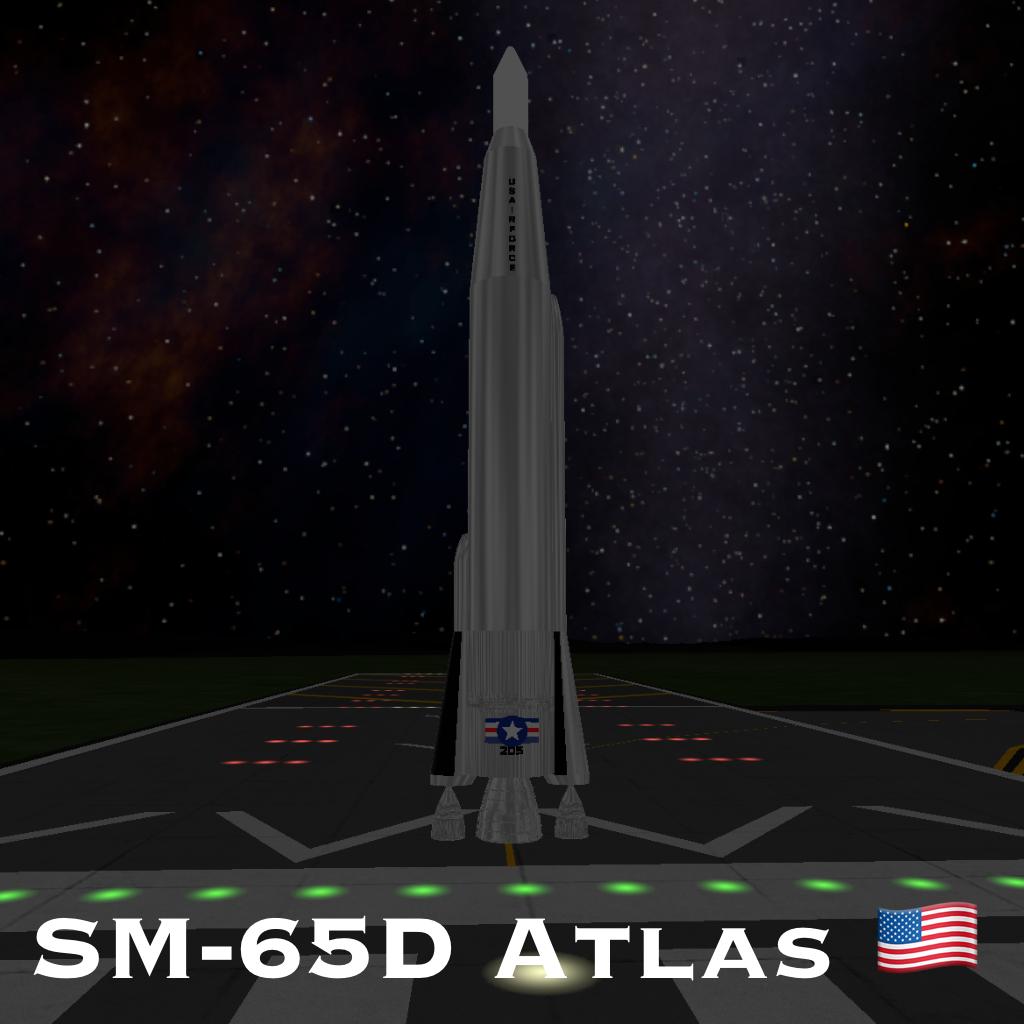
Thanks for SubspaceAerospace for the idea :)
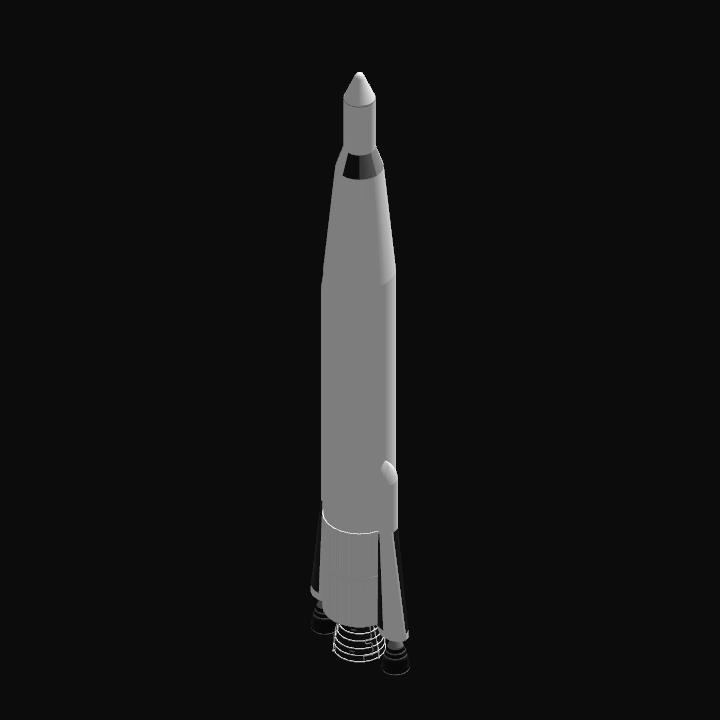
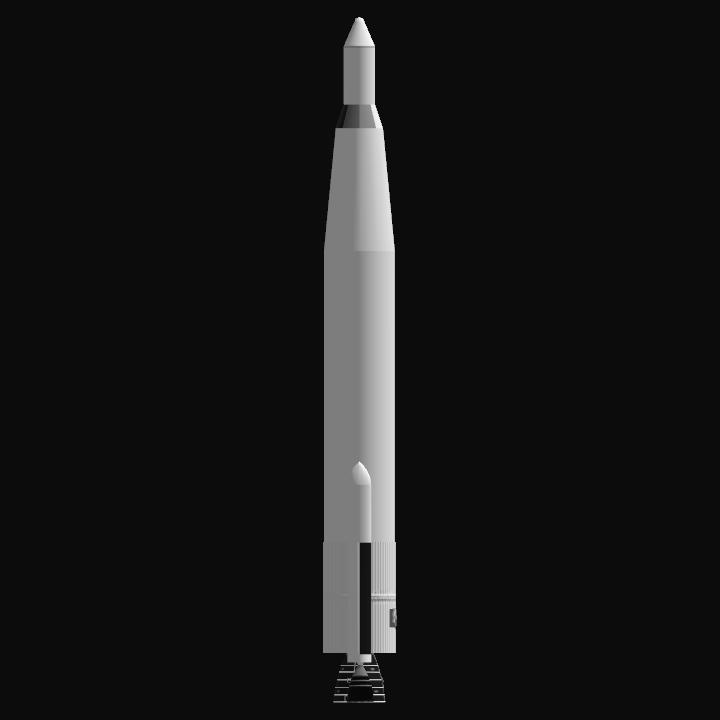
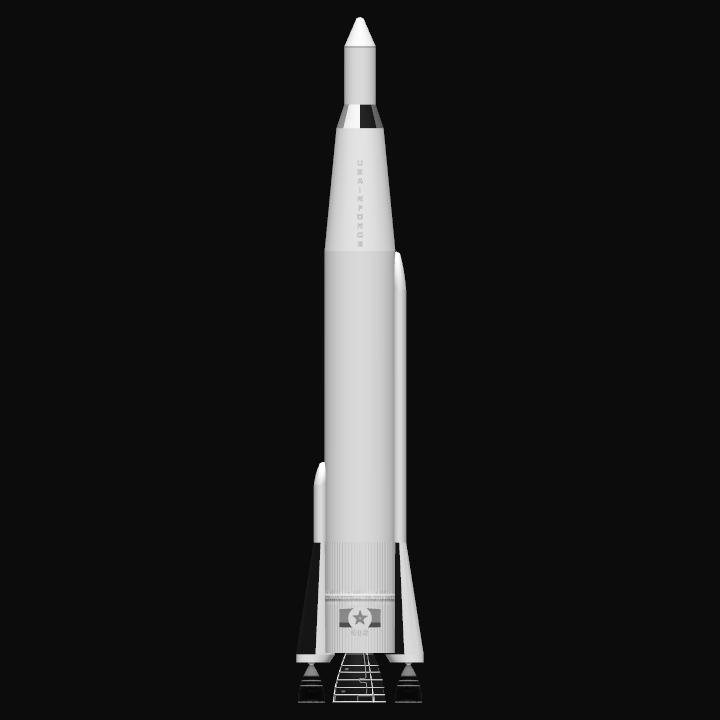
GENERAL INFO
- Created On: iOS
- Game Version: 1.3.205.0
- Price: $21,480k
- Number of Parts: 36
- Dimensions: 35 m x 6 m x 4 m
PERFORMANCE
- Total Delta V: 6.8km/s
- Total Thrust: 2.5MN
- Engines: 3
- Wet Mass: 69,914kg
- Dry Mass: 11,680kg
STAGES
| Stage | Engines | Delta V | Thrust | Burn | Mass |
|---|---|---|---|---|---|
| 1 | 3 | 6.8km/s | 2.5MN | 8.2m | 69,914kg |

Happy new year to all!!!