

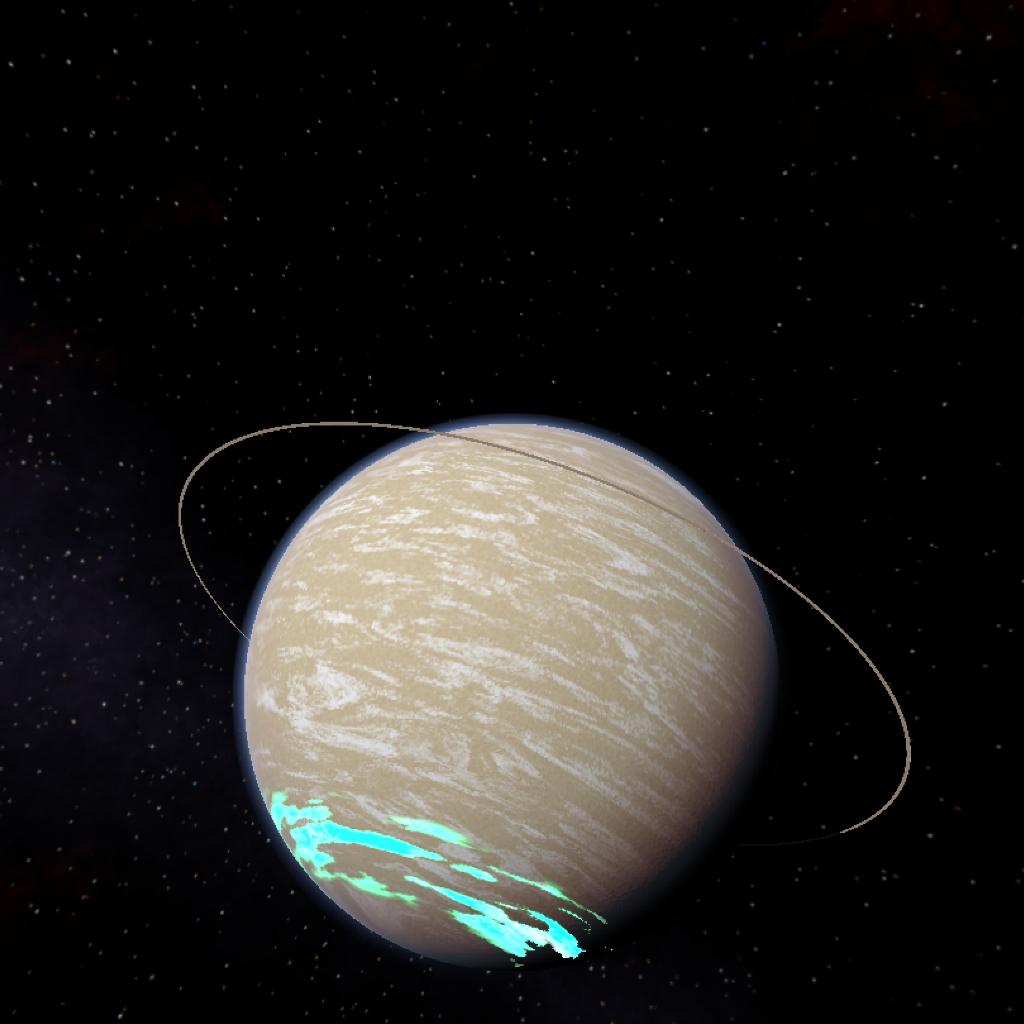
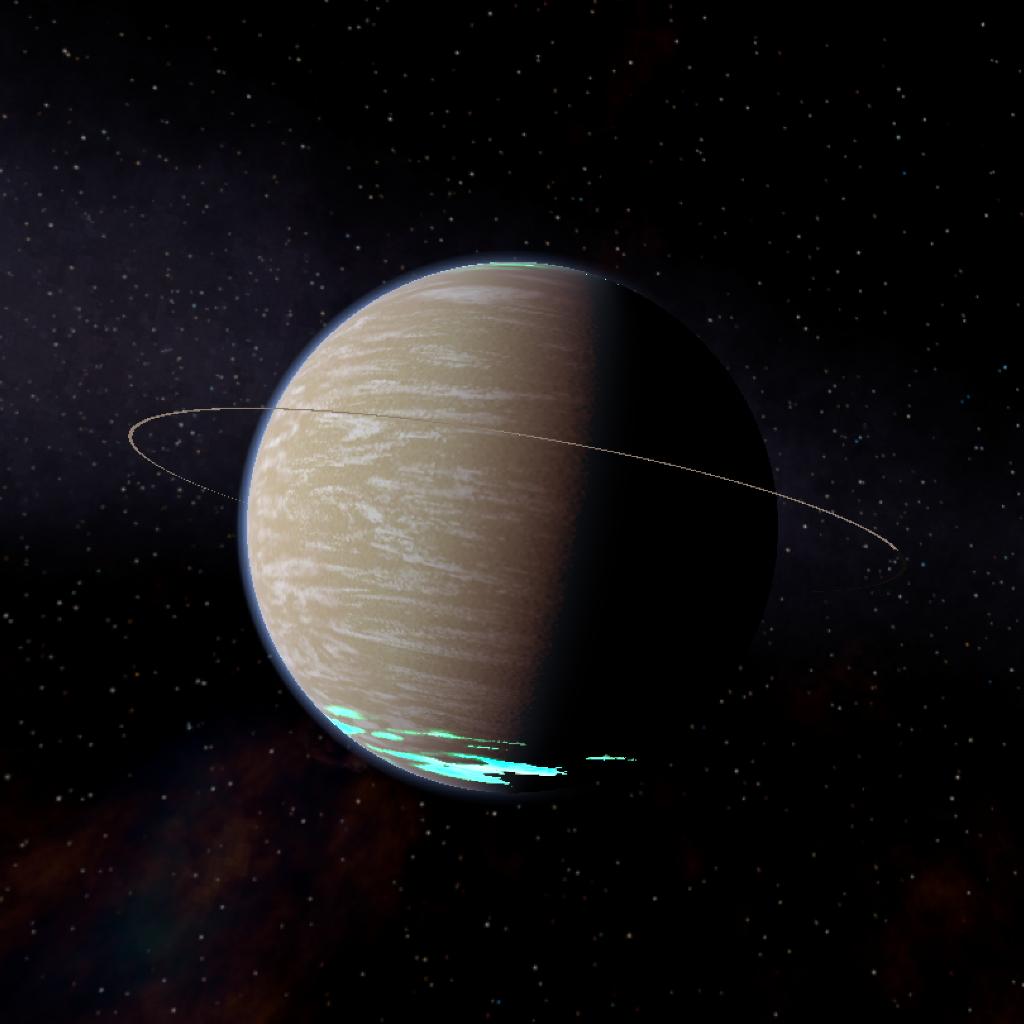
The second moon of Seron:
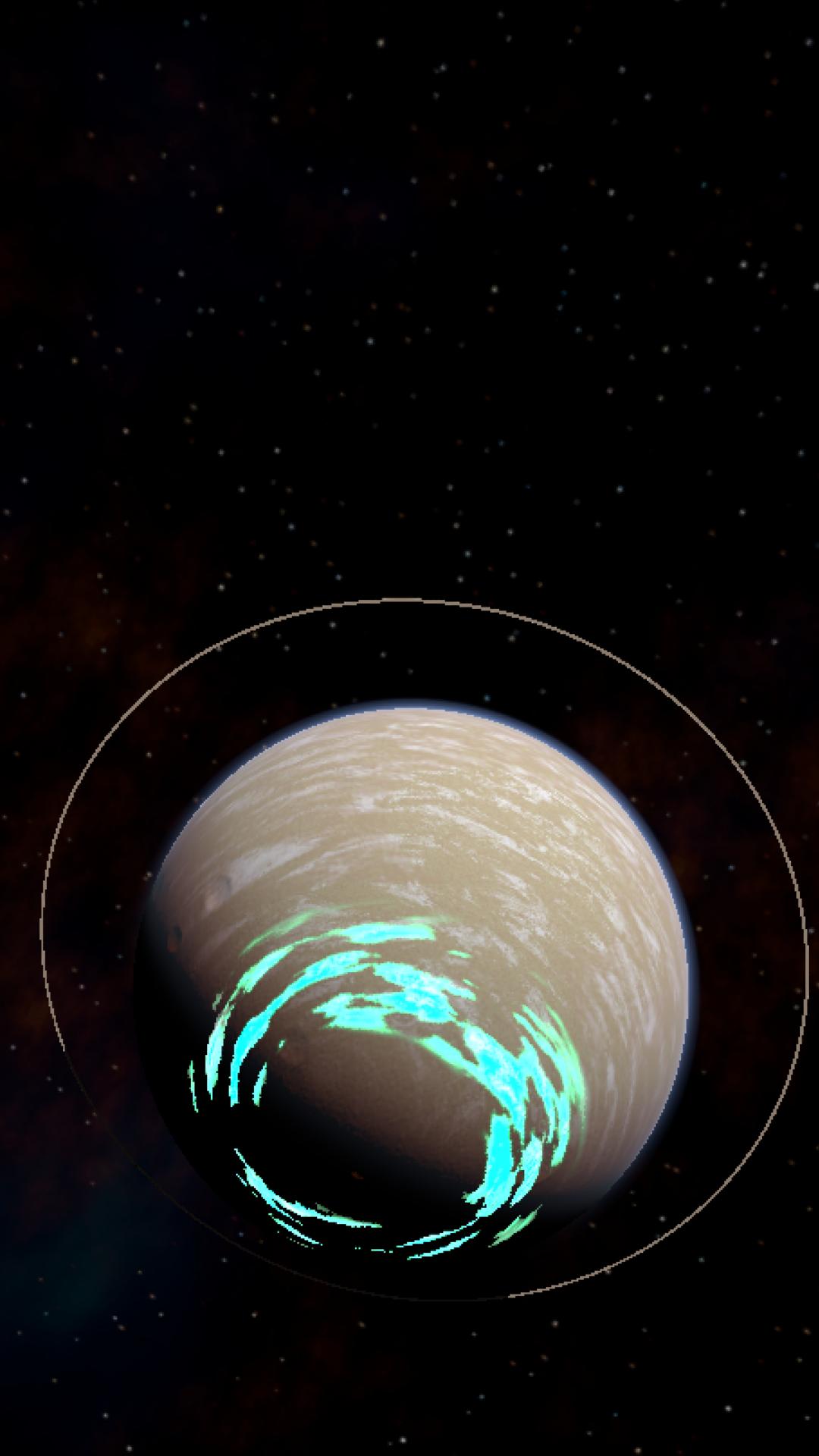
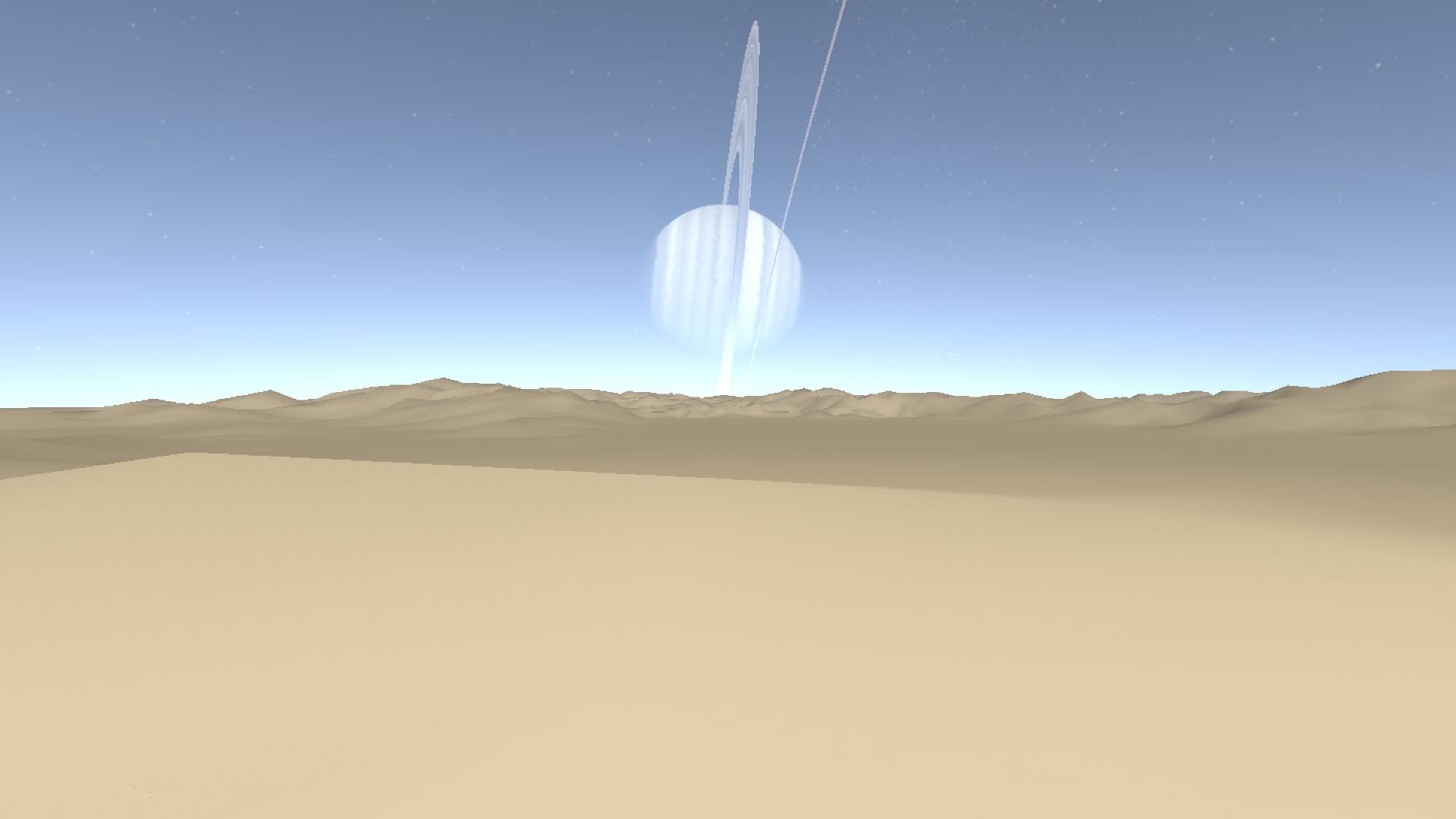
A hot ringed desert world with no life and a surface covered in sand, constantly getting eroded by winds. The strong magnetosphere protects this planet from solar winds causing beautiful auroras at the poles. No water is present at the poles. Some water is present and thats why the atmosphere has so many clouds, the issue is there isn't any liquid water on the hot surface. The size of this moon of Seron is slightly inferior to that of Droo. A colony is possible on this planet but only with constant resupplies or by staying underground where there could very well be some subterranean liquid water. You can admire Seron and its first moon in the sky wich might be the best thing about this planet. close to the planet a small ring system exists made mostly by dust particles and small rocks.
GENERAL INFO
- Created On: Android
- Game Version: 1.3.204.1
CHARACTERISTICS
- Radius: 1,024 km
- Sea Level: None
- Surface Gravity: 9.3 m/s
- Rotational Period: N/A
- Escape Velocity: 4.36 km/s
- Mass: 1.46E+23kg
Atmosphere
- Height: 78 km
- Scale Height: 12 km
- Surface Air Density: 1.200 kg/m3
- Surface Temperature: 308 K
EQUIRECTANGULAR MAP

7 Comments
- Log in to leave a comment
-
10.1k BeaconIndustries3 months ago
@deepfriedfrenchtoast well There are many gasses in that atmo some perhaps do cause the greenhouse effect
-
10.1k BeaconIndustries3 months ago
@Tallisar surface too hot for liquid Rain while High up cold enough
-
12.0k deepfriedfrenchtoast+1 3 months ago
@Tallisar The greenhouse effect would depend on the amount of water vapor in the atmosphere. Judging from the cloud cover the vapor content of the atmosphere seems to be roughly similar to Earth.
Maybe it would be a runaway greenhouse? If it would, then It'd mainly be due to CO2 gas emissions though. The Carbonate–silicate cycle completely shuts down if there's no surface water; if the planet has plate tectonics and is volcanically active then over time all CO2 in the crust would be released into the atmosphere, It doesn't look to be volcanically active though. Maybe the temperatures are high enough for direct carbonate thermal decomposition; a quick US2 simulation gives equator high temperatures of ~457C, from what i've quickly found limestone seemingly starts thermally decomposing into calcium oxide + CO2 somewhere near ~650C. The temp is probably high enough for some more volatile materials to thermally decompose and release gasses like CO2 or SO2, I wouldn't be surprised if that wouldn't cause a fatal runaway greenhouse by itself though.
-
22.4k Tallisar3 months ago
At least 373 degrees Kelvin at the poles, but I'would imagine that the lower latitudes would'not be so good if that were the case. Even if by some miracle that is the case, how could the water most likely be present in the first place? Moreover, I surmise that it would turn into a runaway greenhouse effect, given how water vapor is an extremely potent greenhouse gas. What do you think, @deepfriedfrenchtoast?
-
12.0k deepfriedfrenchtoast3 months ago
@Tallisar All the water would remain trapped in the atmosphere if the entire surface is above 100 degrees C, the average temp would have to be much higher than 308k for even the poles to be boiling though.
-
22.4k Tallisar3 months ago
"Some water is present and thats why the atmosphere has so many clouds, the issue is there isn't any liquid water on the hot surface."
...............
What and how the fuck is that supposed to work or mean 😭
Did you forget how the water cycle works, or something?


NOTE IMPORTANT: Just like Uurl the terrain is buggy so careful when interacting w the mountains.