
Rosenthalescyia, formally designated SHINE-2-A, is classified as a sub-terrestrial planetary body within the SHINE two-star binary system and is confirmed to be in stable circumstellar orbit around the primary stellar component, Astelle. The planet occupies a strategically significant orbital corridor within the greater intersystem transit network linking the Murata and Mayumi star systems.
Rosenthalescyia possesses a measured mean planetary radius of 5,325 km (catalogued survey value: 5,325,584 meters) and a standardized surface gravitational acceleration of 7.15 m/s², placing it below baseline Terran gravity. Internal mass-distribution modeling indicates a disproportionately dense metallic core and lower-mantle enrichment, with a pronounced abundance of ferrous material throughout the lithosphere.
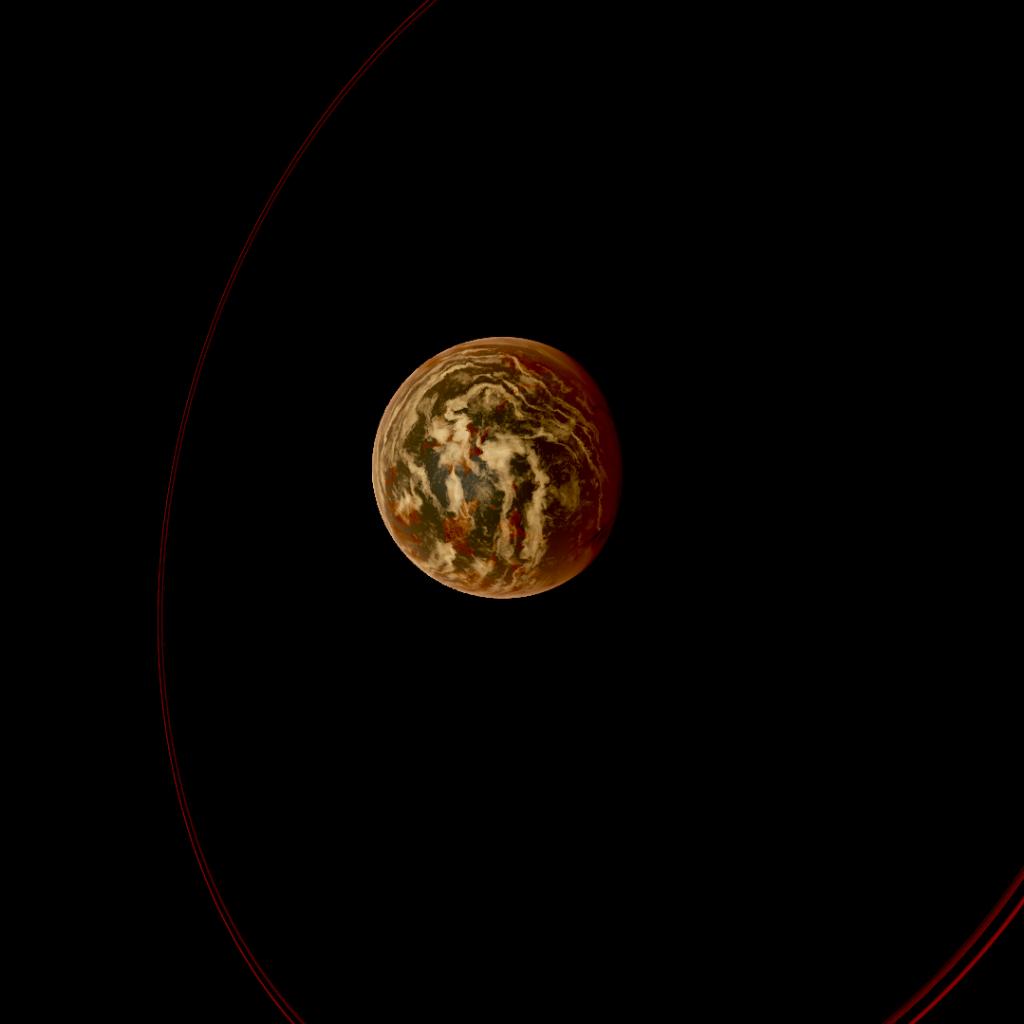
Geochemical surveys confirm sustained seepage of dissolved iron and related oxides from the planetary crust into the global hydrosphere. This persistent mineral influx has resulted in extensive oxidation processes across exposed continental surfaces and shallow seabeds, producing the planet’s characteristic rust-colored landmasses and green-tinted oceanic basins. Spectral imaging further indicates that suspended iron compounds within the upper water column significantly alter light scattering, contributing to the unusual coloration observed from orbital altitudes.
The planetary atmosphere remains structurally stable and exhibits long-term retention of layered cloud systems. Cloud morphology and circulation patterns fall within normal parameters for a body of comparable mass and rotation period. However, the lower and mid-atmospheric strata contain a high concentration of optically active particulate matter and trace metallic aerosols. Combined with localized chemical absorbers, this produces a distinctive crimson-red atmospheric hue when observed under direct stellar illumination. Despite its coloration, atmospheric density and pressure profiles remain compatible with standard human-rated surface operations following routine environmental conditioning.
Rosenthalescyia is encircled by a well-defined particulate ring system. The primary ring plane is inclined at approximately seventy-five degrees relative to the planet’s equatorial plane. Orbital stability modeling confirms that the ring structure is dynamically long-lived, with minimal measurable decay and no immediate threat to low-orbit infrastructure when standard exclusion corridors are maintained. The pronounced axial presentation of the rings has become a primary navigational landmark for inbound vessels.
The planet hosts a permanent human settlement registered under Colonial Habitation Index C-18. The settlement is officially classified as a multi-function logistics and support installation, designed to accommodate extended crew rotations, technical maintenance operations, and emergency diversion traffic. While formally designated C-18 in all administrative documentation, the settlement is widely referred to—both by its resident population and by off-world flight authorities—by the informal operational name “Opportunity.”
C-18 maintains a stabilized surface perimeter, pressurized habitation sectors, orbital traffic coordination facilities, and heavy-duty repair platforms capable of servicing mid- and long-range intersystem spacecraft. Infrastructure expansion over successive operational cycles has gradually transformed the site from a limited resupply outpost into a fully integrated support hub with medical, fabrication, and modular replacement capabilities.
From a strategic and logistical perspective, Rosenthalescyia serves as a recognized gateway node between the Murata Star System and the Mayumi System. Its orbital placement and gravitational parameters allow for highly efficient transfer trajectories and low-energy course corrections for vessels operating along the principal intersystem transit lanes.
As a result of this positional advantage, Rosenthalescyia is routinely utilized as an auxiliary destination for spacecraft originally scheduled for Szelle-bound routes. In such cases, the planet functions as an officially sanctioned diversion and contingency stop for refuelling, structural repair, cargo stabilization, crew rotation, and systems recalibration. This secondary role has been incorporated into multiple navigation and emergency-routing frameworks, and the planet is now formally recognized as a critical redundancy node within the broader regional transport network.
To put it simply:
"Rosenthalescyia, designated SHINE--2-A. Part of the SHINE Two-star binary system, Rosenthalescyia is a sub-earth type planet, with excess iron leaking into the oceans, resulting in rust-colored terrain and greenish oceans. Clouds still presist normally while the atmosphere itself is mainly crimson-red.
The planet itself has a ring system angled at ~75 degrees. The planet houses a permanent human settlement designated as C-18. Nicknamed by its inhabitants and other sources as "Opportunity".
Rosenthalescyia acts as a gateway between the Murata Star System and Mayumi System. Due to it, Rosenthalescyia is sometimes used as an alternative destination for Szelle-bound spacecraft to refuel, repair, etc."
GENERAL INFO
- Predecessor: Hadean
- Created On: Windows
- Game Version: 1.3.205.0
CHARACTERISTICS
- Radius: 5,326 km
- Sea Level: -2,000 m
- Surface Gravity: 7.2 m/s
- Rotational Period: N/A
- Escape Velocity: 8.73 km/s
- Mass: 3.04E+24kg
Atmosphere
- Height: 185 km
- Scale Height: 27 km
- Surface Air Density: 2.919 kg/m3
- Surface Temperature: 301 K
EQUIRECTANGULAR MAP